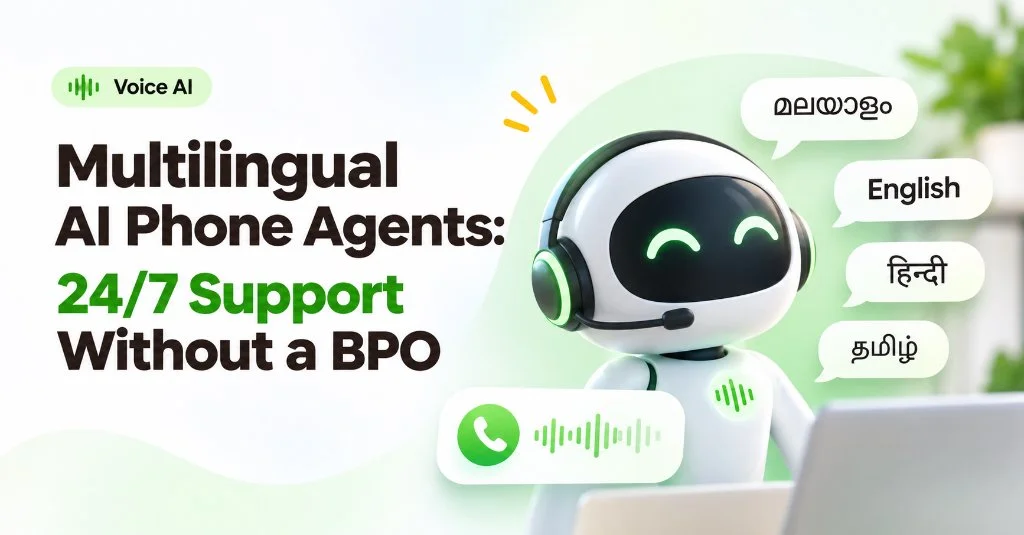
In a globalized yet regionally diverse economy, language is the single biggest driver of customer trust.
According to research from CSA Research, 76% of consumers prefer purchasing products with customer service available in their native language, and more than 60% will abandon a business entirely if phone support is only available in a language they struggle to speak comfortably.
Whether you run a healthcare clinic in Kerala, an e-commerce brand serving South India, or a service business catering to diverse linguistic communities across the globe, telephone support has always had a painful tradeoff:
- Hire expensive bilingual call centers: Maintain multiple shifts of multi-lingual human agents at ₹25,000 to ₹45,000+ per month per telecaller.
- Force callers through rigid keypad menus: "Press 1 for English, Press 2 for Malayalam, Press 3 for Hindi..."—a system that causes up to 65% of callers to hang up before ever speaking to a representative.
- Leave non-English callers unattended: Forcing callers to speak English or losing their business to local competitors.
In 2026, multilingual AI phone agents have eliminated this tradeoff entirely.
Modern conversational voice agents can listen, comprehend, and converse naturally across multiple languages and regional dialects—auto-detecting the caller's spoken language on the fly without touch-tone menus, and resolving customer inquiries at a fraction of the cost of a traditional BPO.
Want to hear natural multilingual Voice AI?
Listen to live conversational demos in Malayalam, English, and regional dialects using the Binate Voice AI Demo.
Why Legacy Phone Menus and Multilingual BPOs Are Failing
For decades, companies needing non-English phone support relied on two models: outsourced Business Process Outsourcing (BPO) call centers or keypad Interactive Voice Response (IVR) systems.
Both approaches create severe operational bottlenecks in modern customer service:
1. The High Cost and High Turnover of Bilingual Call Centers
Hiring human agents who are fluent in specialized regional languages (such as Malayalam, Tamil, German, or Spanish) is expensive. To provide round-the-clock 24/7 coverage across three shifts, a business must hire at least 3 to 4 full-time agents per language:
Traditional BPO Staffing Math:
  3 Languages × 3 Shifts (24/7) = 9 Full-Time Customer Service Agents
  Average Monthly Salary + Overhead: ₹25,000 per agent (entry-level)
  Total Monthly Operating Expense: ₹2,25,000+ per month
Compounding the financial cost is attrition: the average contact center suffers from an annual employee turnover rate exceeding 45%. Every few months, businesses must recruit, onboard, and train new representatives on product catalogs, medical terms, and CRM tools.
2. The 65% IVR Abandonment Rate
When businesses attempt to automate multilingual routing using traditional IVR trees, customer friction spikes immediately. Callers are forced to listen to lengthy multi-tier audio prompts before they can even state their problem:
"Welcome to City Hospital. For English, press 1. മലയാളത്തിന് 2 അമർത്തുക. हिन्दी के लिए 3 दबाएं..."
By the time the caller navigates the keypad, over 65% have hung up in frustration. If a caller chooses English but speaks with a heavy regional accent or uses vernacular idioms, traditional voice bots fail completely.
How Multilingual Voice AI Works (Without Keypad Menus)
Modern autonomous voice platforms replace mechanical phone trees with neural acoustic language detection and natural speech generation:
[Incoming Caller Speaks]
  "ഹലോ, എനിക്ക് നാളത്തെ ഡോക്ടർ അപ്പോയിന്റ്മെന്റ് ഒന്ന് ബുക്ക് ചെയ്യണം."
        │
        ▼
[Acoustic Language Classifier (Sub-400ms)]
        │ ──▶ Instantly identifies: Language = Malayalam | Dialect = Central Kerala
        ▼
[Contextual LLM Reasoning Engine]
        │ ──▶ Understands intent: "Book Doctor Appointment for Tomorrow"
        │ ──▶ Checks real-time calendar slots in clinic database
        ▼
[Neural Vernacular Text-to-Speech (TTS)]
        │ ──▶ Generates natural spoken response in identical language & tone:
  "തീർച്ചയായും, നാളെ രാവിലെ 10:30-ന് ഡോക്ടർ ജോസഫിന്റെ സ്ലോട്ട് ഒഴിവുണ്ട്. അത് ബുക്ക് ചെയ്യട്ടേ?"
Unlike legacy systems, the caller never presses a number. They speak naturally from the very first second, and the voice agent seamlessly answers in their chosen language.
The Code-Switching Challenge: Why Generic Translation APIs Fail
The biggest technical flaw in generic voice bots (built on basic Google Translate or English-first models) is their inability to understand code-switching.
In real-world conversations, regional callers rarely speak in pure dictionary sentences. Instead, they blend languages within the exact same phrase:
- Manglish (Kerala): "Ente order-inte status onnu check cheyyamo? Tomorrow morning delivery aakumo?" (Malayalam + English)
- Hinglish (North India): "Mera payment cut ho gaya but confirmation email nahi aaya, can you help?" (Hindi + English)
- Spanglish (US / Latin America): "Quiero hacer una appointment para regular maintenance, por favor." (Spanish + English)
When a standard voice bot encounters code-switching, its Speech-to-Text (STT) engine treats the foreign words as audio noise or misspellings, causing the entire conversation to hallucinate or drop.
Advanced multilingual engines like Binate's Indic Voice Architecture are trained on phonetic acoustic embeddings that natively accommodate colloquial hybrid dialects. The AI understands the underlying intent regardless of how frequently the speaker alternates between languages.
Multilingual Call Centers vs. AI Phone Agents
Here is how hiring a traditional multilingual call center compares to deploying an autonomous voice agent:
| Operational Dimension | Multilingual Human BPO Call Center | Autonomous Multilingual AI Phone Agent |
|---|---|---|
| Language Switching | Requires transferring call to another rep | Instant dynamic switching mid-sentence |
| Simultaneous Concurrency | Bottlenecked by agent headcount | Unlimited concurrent lines (0 busy signals) |
| Cost Structure | High monthly salaries + shift differentials | Transparent usage (sub-₹6 per minute) |
| Night & Weekend Coverage | 1.5x – 2x overtime staffing costs | Included 24/7/365 coverage with zero surcharges |
| Response Latency | 30s to 5 mins on hold during peak rushes | Zero hold time (Answers on 1st ring / sub-400ms) |
| Data Consistency | High human error in manual CRM logging | 100% structured sync to Zoho, LeadSquared, HubSpot |
| Code-Switching Support | Varies widely based on agent background | Native phonetic model training (Manglish, Hinglish) |
High-Impact Industry Use Cases
Multilingual voice AI is transforming operations across industries where voice remains the dominant channel of communication:
1. Healthcare Clinics & Hospitals
When an elderly patient or family member calls a clinic with medical concerns, they are often stressed and naturally default to their mother tongue.
An AI medical receptionist speaks with empathetic regional cadence, answers doctor availability queries, collects symptoms, and schedules outpatient (OPD) tokens directly into the hospital management software—whether the patient speaks Malayalam, Tamil, or English. (Read our complete guide on AI receptionists for clinics in Kerala).
2. Direct-to-Consumer (D2C) & E-Commerce
In regional e-commerce markets, high Return-to-Origin (RTO) rates on Cash-on-Delivery (COD) orders are the number one profit killer.
Multilingual voice agents call customers within minutes of order placement to verify addresses, confirm delivery timelines, and resolve payment questions in their local language, reducing RTO rates by up to 32% across regional pin codes.
3. Local Real Estate & Financial Services
Prospective property buyers and loan applicants want immediate answers to basic eligibility and pricing questions. An AI voice agent qualifies incoming inquiries, answers property specs in the caller's dialect, and books site visits on the sales manager's calendar.
How to Deploy a Multilingual Voice Agent in 4 Steps
Deploying a multilingual voice agent no longer requires custom machine-learning engineering:
Step 1: Select Your Primary & Secondary Languages
Define your core language matrix based on your caller demographics (e.g., English, Malayalam, and Hindi). Configure your agent's default greeting and enable auto-detection mode.
Step 2: Upload Localized Knowledge Bases
Provide your FAQ documents, service lists, and pricing sheets. Modern platforms allow you to upload English documentation; the underlying LLM dynamically translates and contextualizes the answers into the caller's language with correct colloquial phrasing.
Step 3: Establish Fallback & Escalation Rules
Configure human handoff triggers. If a caller asks complex technical questions or requests to speak to a senior executive, the AI executes an immediate warm SIP transfer to your human team along with an instant language summary.
Step 4: Connect Calendar & CRM Integrations
Link your voice agent to your Zoho CRM, LeadSquared, or HubSpot database. The voice engine will automatically log caller transcripts, language preference, city location, and appointment tokens the second the call concludes.
Frequently Asked Questions
Yes. Modern voice AI monitors acoustic and semantic tokens on every single turn. If a caller starts in English and switches to Malayalam or Hindi midway through the conversation, the agent seamlessly transitions to the caller's preferred language without missing context.
Specialized regional voice engines are trained on conversational phonetic datasets rather than robotic studio recordings. They accurately recognize local accents across districts (such as Malabar, Travancore, or urban South Indian accents) as well as common informal slang.
No. Unlike legacy IVR phone menus that force callers to press 1 or 2, modern multilingual AI agents detect the spoken language within the first 400 milliseconds of the caller speaking and reply naturally in that exact language.
Yes. Staffing a 24/7 multilingual team across three shifts typically costs upwards of ₹2,00,000 to ₹3,00,000 per month across languages and shifts. A multilingual AI voice agent operates on predictable pay-as-you-go pricing starting at a fraction of that cost, with zero overtime or holiday surcharges.
Deliver 24/7 Phone Support in Every Customer's Language
Break language barriers and capture every inbound caller with an autonomous multilingual voice agent engineered for natural conversation.
Test Live Multilingual Demo →